
St. Landry LAVNS and VINELink Coverage
Louisiana calls its statewide service the Louisiana Automated Victim Notification System, or LAVNS. The public web interface is Louisiana VINELink. The Louisiana Commission on Law Enforcement manages the statewide system, and Louisiana DPS&C participates. The state LAVNS description says it can track events that include arrest, bail, hearings, sentencing, incarceration, and release.
The St. Landry Parish Sheriff’s official jail roster links users to LAVNS notification. DPS&C also says LAVNS search data include prison plus probation and parole populations and are updated every 24 hours. Exact local participation should still be checked in the agency selector or matched result because no complete current parish-by-parish participation table was identified.
Coverage is not proof of a final outcome. An agency event may mark release from its custody while another agency takes control. A person on parole or probation can live outside a prison and remain visible because supervision continues. Someone missing from search may be fully discharged, recorded under another spelling, outside a participating data set, or affected by a reporting delay.
- LAVNS
- Louisiana’s custody-event search and notification system.
- VINELink
- The public interface used to search participating Louisiana records and manage alerts.
- Custody event
- An agency-reported change such as release, transfer, or another status update.
- Discharge
- The official end of the relevant custody or supervision term.
Search a St. Landry Inmate on VINELink
The search is meant for a known person, not a browse of everyone released from St. Landry Parish. Start with enough information to distinguish similar names. A name alone can return more than one person, and the agency supplying the record matters just as much as the status label.
- Open Louisiana in VINELink and choose “Search for a Person.”
- Enter the full name or an available identification number. Use spelling variants only when the first search fails.
- Review possible matches. Compare date of birth, identifier, reporting agency, and facility before opening a record.
- Read the custody status, agency, location, event, and displayed timestamp together. Do not treat one isolated field as the whole record.
- If the record belongs to the correct person, save the identifying details and lookup date before registering for notice.
- For formal proof, contact the agency that supplied the event and obtain its release, transfer, or discharge record.
The official Louisiana VINELink interface illustrates the search route and the agency-driven record format.
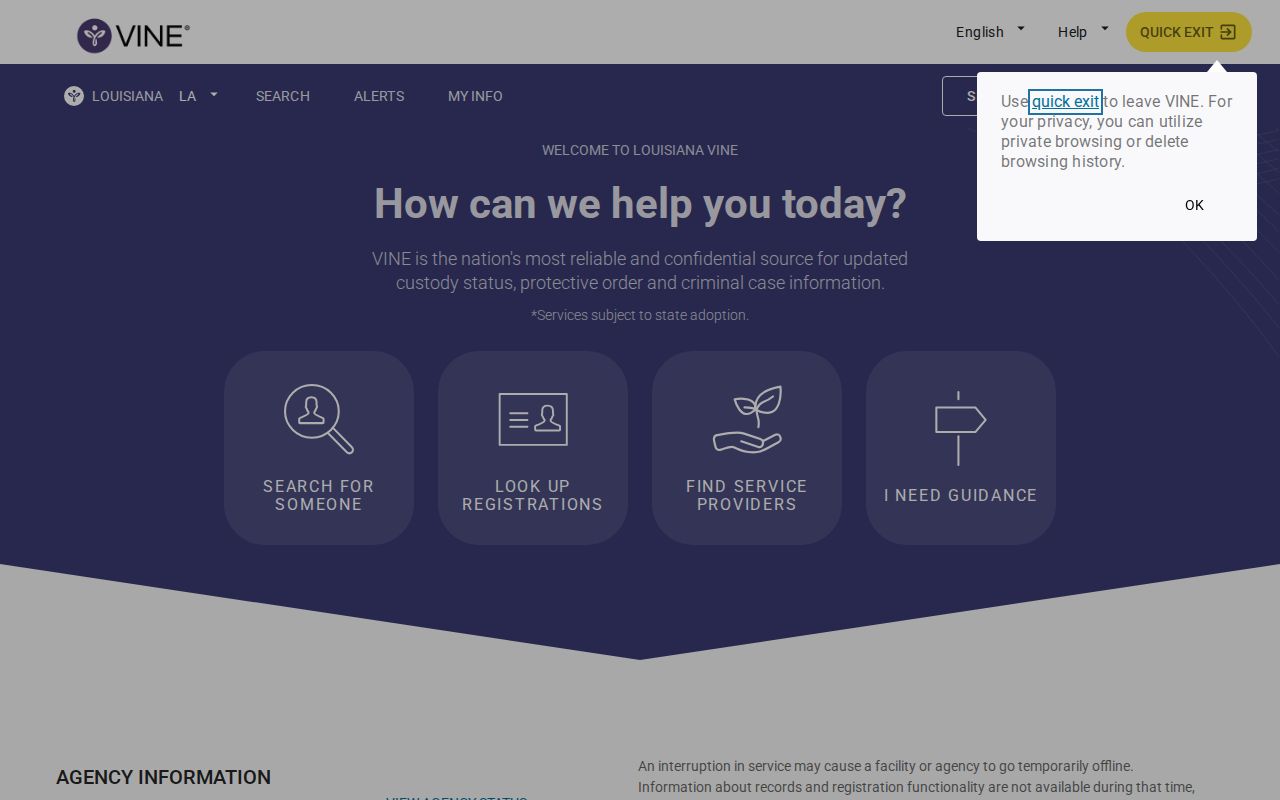
The result must be read in its own context. If no suitable released-person fields are displayed, do not import field names from another state or assume the release date. The St. Landry Parish released inmate search supplies the jail-record and court fallback when VINELink cannot settle the question.
Note: Match the person and reporting agency before relying on a status; a same-name result can describe a different custody case.
St. Landry VINELink Release Fields
VINELink displays information supplied by the participating agency. The interface can change, and not every agency exposes the same set of fields. Record only what the matched result actually renders. A projected date, actual release event, current location, and supervision status are separate facts.
| Field | How to read it |
|---|---|
| Name and identifier | Use them to distinguish the correct person from similar names. |
| Reporting agency | Shows which jail, prison system, or supervision source supplied the event. |
| Custody status | Describes the agency-reported state, which may be in custody, released, transferred, or supervised. |
| Facility or location | Identifies the reported custodian or supervision location, not always a physical prison. |
| Event or release information | Use the exact rendered label and date. Do not convert a projected date into actual release. |
| Record timestamp | Shows the context for an update and helps explain later changes or lag. |
A released result proves only what the reporting agency says it did. For the St. Landry Parish Jail, ask the sheriff’s records channel for final release date and time, authority, reason, and destination if maintained. For a state prison record, ask DPS&C for the underlying master-prison or release record. The court file supplies the legal disposition.
Register for St. Landry Release Alerts
Registration is prospective. It tells the system where to send an alert if the matched agency record changes. Register only after confirming the person and agency. Offered methods may include text, email, telephone, or an in-app notice, and available choices can vary by agency.
- Open the correct person’s record and choose “Register for Notifications.”
- Select one of the delivery methods offered for that record.
- Enter the phone number, email address, or account destination accurately.
- Complete the confirmation prompts. Current interface components may use a six-character confirmation code and a managed registration PIN.
- Save the confirmation and PIN details. Use the VINELink registration tools when a phone number, email, or delivery choice changes.
- When an alert arrives, confirm the person, agency, event type, and actual destination through the agency record.
Do not hard-code an assumed four-digit PIN into personal instructions. The current process and agency configuration control the prompt. VINELink operator help is available at 866-277-7477 at all times, with multilingual assistance. Louisiana’s LAVNS toll-free line is 866-528-6748.
An alert can be fast and useful, but it is not a certified record. If the notice says “release,” ask whether the event means community release, bond, transfer, discharge, or another custody change. Preserve the alert time, then request the official record.
St. Landry LAVNS and LAVO Differ
Louisiana has two registrations that are easy to confuse. LAVNS and VINELink handle participating custody events. The Louisiana Victim Outreach Program, called LAVO, is a separate state-prison notice route. Registering in one does not enroll a person in the other.
LAVO provides outreach concerning projected state-prison release, actual prison release, sentence-changing rulings, pardon and parole hearings, escape or apprehension, transitional work assignment, and release by other means. That broader state-prison role does not make LAVO a St. Landry Parish recent-release list.
The DPS&C Victim Services source explains the distinction.
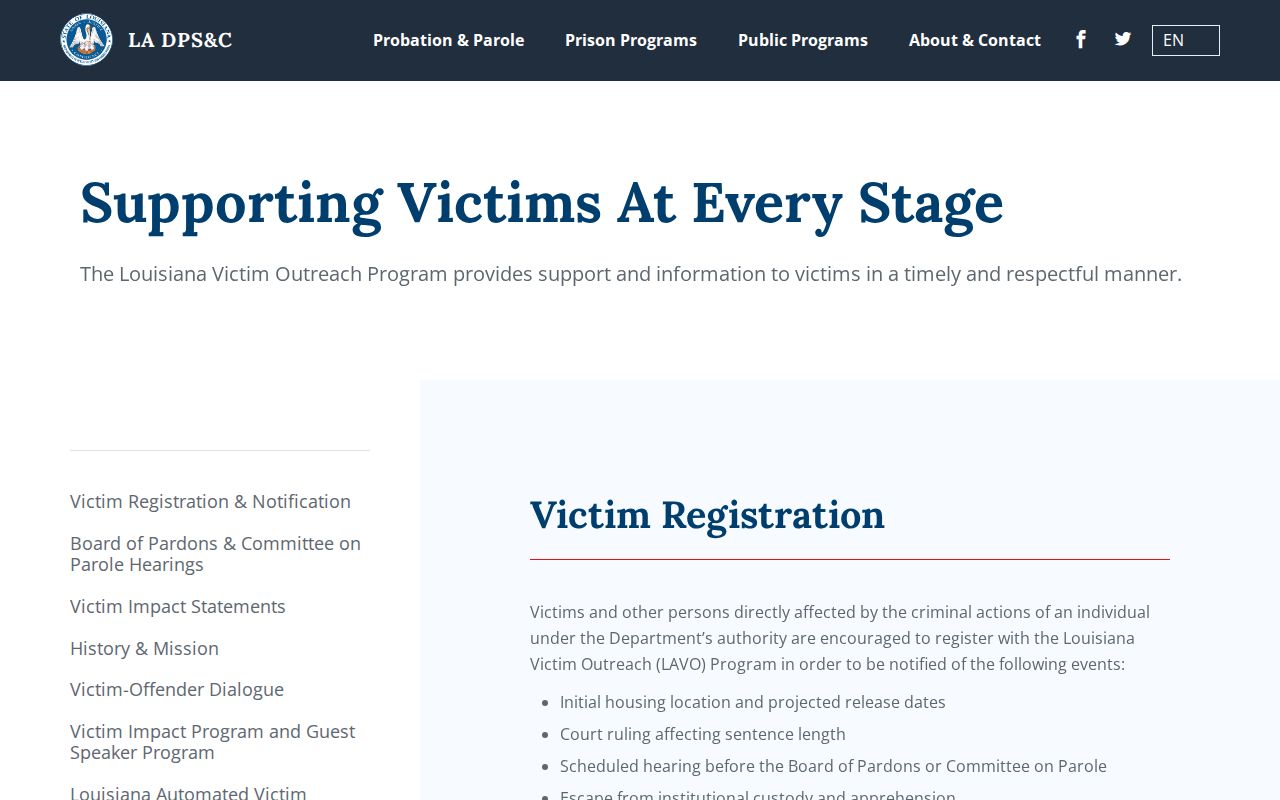
LAVO can be reached at 225-342-1056, 888-342-6110, or gail.guerin@la.gov. Use LAVNS for the matched participating custody record and LAVO for the separate state-prison outreach described by DPS&C.
Note: A local LAVNS registration does not enroll the same person for LAVO’s state-prison projected and actual release notices.
Limits of St. Landry VINELink Results
VINELink does not cover every custody system. The Federal Bureau of Prisons has its own inmate locator and federal custody information for sentenced federal people. ICE uses its Online Detainee Locator for immigration custody. U.S. Marshals prisoner information explains the federal pretrial role; confirmation may require the federal court and responsible agency because USMS has no broad public historical release locator comparable to BOP.
System timing is another limit. DPS&C describes LAVNS data as updated every 24 hours, not minute by minute. A new booking, transfer, release, or supervision update may not appear at once. The St. Landry jail roster also carries a timestamp and is a current incarcerated-person snapshot, not a historical release archive. An absence from both screens cannot prove release.
Coverage can also end. A fully discharged person may no longer fall within the population the public state page promises to search. Confidential, sealed, expunged, older, short-term, misspelled, or transferred matters can be absent. Narrow records requests and the correct court jurisdiction remain necessary when the online systems return nothing.
| Custody type | Correct route | VINELink limit |
|---|---|---|
| St. Landry parish jail | Roster, LAVNS alert, sheriff release record, and court file | No-match does not prove a community release |
| Louisiana state prison | LAVNS/DPS&C plus LAVO when appropriate | Projected date is not actual release |
| Federal sentence | BOP Inmate Locator and federal record | Not covered by Louisiana VINELink |
| ICE custody | ICE Online Detainee Locator | Not a parish release archive |
St. Landry Release Registry Limits
The Louisiana State Police registry is a narrow post-release channel for people who have a legal registration duty. It is not a general list of St. Landry Parish released inmates, and it does not prove when or why jail or prison custody ended.
Registry information comes from courts, corrections, and law-enforcement agencies and may not be complete or current. Match the person carefully and direct disputed information to the State Registry or the appropriate local agency. A registry result should never replace the Sheriff release record, DPS&C record, or controlling court file.
Confirm a St. Landry VINELink Alert
Start with the agency shown on the notice. If St. Landry Parish Jail supplied it, use the St. Landry Parish Sheriff’s Office public-information channel to request the existing booking and release record. Ask narrowly for the final release date and time, reason, authority, destination or receiving agency, and related order reference if maintained. The official jail location entry supplies the current-status telephone.
If DPS&C supplied the event, use its official information route and request the underlying releasable state record when formal proof is needed. If parole is involved, verify the Committee outcome and the assigned supervision office. The Ville Platte Probation and Parole District represents St. Landry Parish. A supervision entry means the person may be out of prison while the sentence continues.
Then read the court file. It can show bond, disposition, judgment, sentence, and later revocation or completion entries. The operational record proves the agency’s action; the court record explains the legal authority. If a receiving agency is named, follow that system before describing the person as back in the community.
Keep the event sequence intact when several systems disagree. Note the roster timestamp, the VINELink lookup time, the agency named in the alert, and the date on the final record. A delay between those sources may be normal. A different destination may reveal a transfer. The strongest conclusion comes from matching the same person and custody episode across all four details.
This final check gives the alert its proper role. VINELink provides timely notice and a strong lead. The originating government records establish what happened.