
St. Landry Projected Versus Actual Release
A projected release date is a working sentence calculation. It is built from the judgment, sentence length, jail credit, whether terms run together or one after another, statutory eligibility, and earned credit. Louisiana DPS&C uses the exact phrase “projected release date (if applicable)” for information available through its telephone locator. The qualifier matters. A date may not yet exist if official sentencing papers have not reached the agency or the master prison record is incomplete.
An actual release date records an event that occurred. It can show when the responsible agency ended its custody, but the destination still matters. A person may return to the community, begin supervision, or move to another custodian. Leaving the St. Landry Parish Jail for DPS&C, ICE, another jail, or federal custody is a transfer, not proof of community release.
Pretrial detention is different. Someone awaiting trial does not have a sentence to calculate. Bond action, dismissal, a court order, a plea, or later sentencing may alter custody, but none creates a sound projected date until the controlling legal event occurs.
Find a St. Landry Projected Release Date
Begin with custody type. The St. Landry Parish Sheriff’s Office Corrections page says the jail holds both people awaiting trial and people who have been convicted. Louisiana DPS&C handles statewide prison records after commitment or transfer. The local roster is a timestamped current-custody list and does not display a final release date in its public list view. A sound search therefore changes with the sentence.
- Confirm the last known custodian. Use the parish roster only to test current jail custody at its displayed snapshot time.
- Read the court judgment and minute entries. Identify whether there is a sentence, its length, jail credit, and whether multiple terms are concurrent or consecutive.
- For a state prisoner, call the DPS&C locator at 225-383-4580 with the DPS&C number or the name and date of birth. Ask for the projected release date if applicable.
- For a parish sentence, use the official St. Landry Parish Jail contact and the controlling court for the existing sentence and calculation records.
- If the computation appears incomplete or disputed, direct sentence-calculation questions to DPS&C at 225-342-0799.
- When the date arrives, confirm the actual event through the jail or DPS&C record and check any named receiving agency or supervision office.
The official DPS&C information screen explains the locator route and its limits.
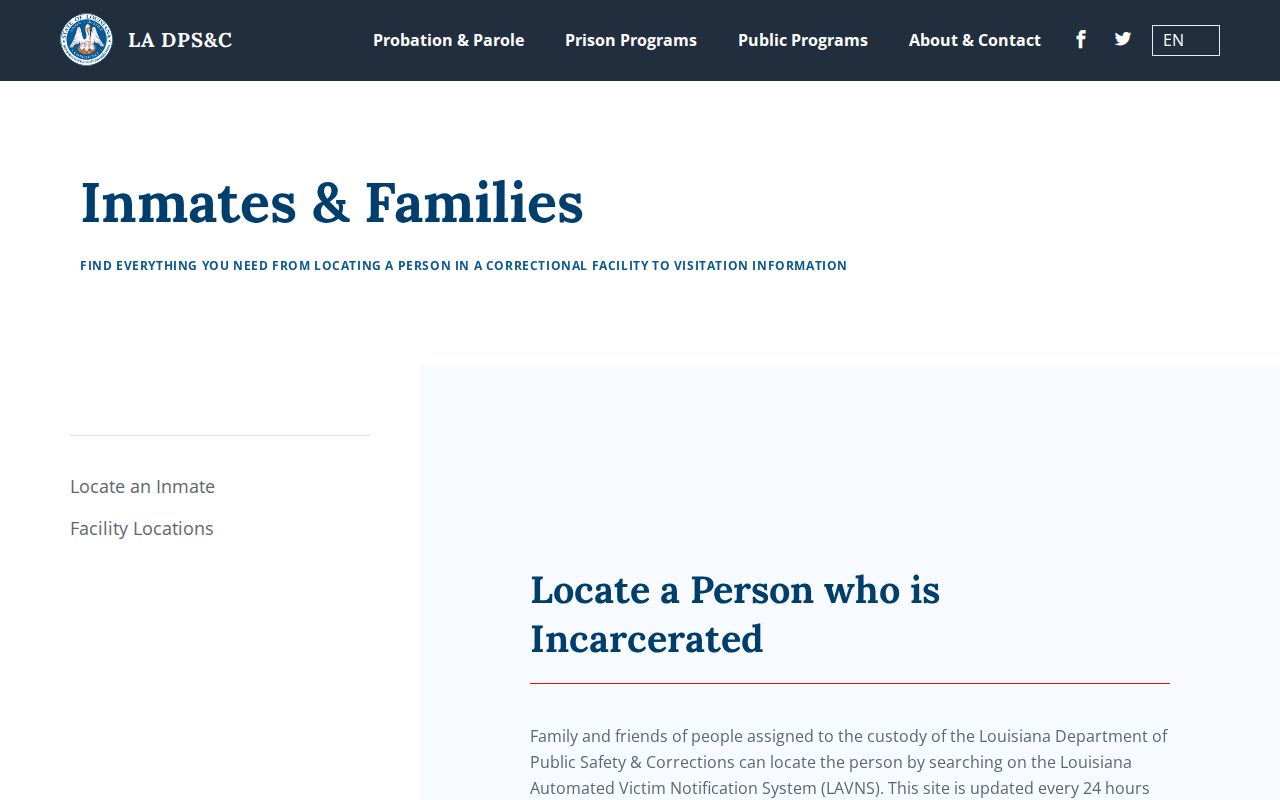
That page is the correct statewide starting point for a sentenced state prisoner, while the St. Landry Parish release-record path remains the route for a local jail exit.
Note: A person missing from the live parish roster may have transferred, so an empty result is not an actual release date.
St. Landry Good-Time Release Rules
Good time, formally called diminution of sentence, can reduce the time served by an eligible person who follows the governing rules. Louisiana does not use one universal rate. R.S. 15:571.3 sets different rates and exclusions based on factors such as sentence location, offense class, prior convictions, and the applicable version of law. A quick percentage cannot replace the official calculation.
For an eligible parish-prison sentence without hard labor, the current statute allows 30 days of credit for each 30 days actually served in a qualifying nonviolent case. A qualifying first crime of violence under that parish provision earns three credit days for each 17 actual days. That is the narrow source of an 85% actual-service formula. A second crime of violence is excluded under that provision, and the sheriff of the parish of conviction has the statutory earning determination under sheriff regulations.
DPS&C sentences use other current rates. Eligible nonviolent cases may receive 13 credit days for every seven days actually served. A qualifying first violent conviction may receive one day for every three served. Other cohort rules and exclusions apply, including limits involving habitual-offender and sex-offense classifications. These differences make offense history, sentence place, conviction date, and the statute controlling the individual record essential.
The official good-time statute screen shows the rule that governs these separate categories.
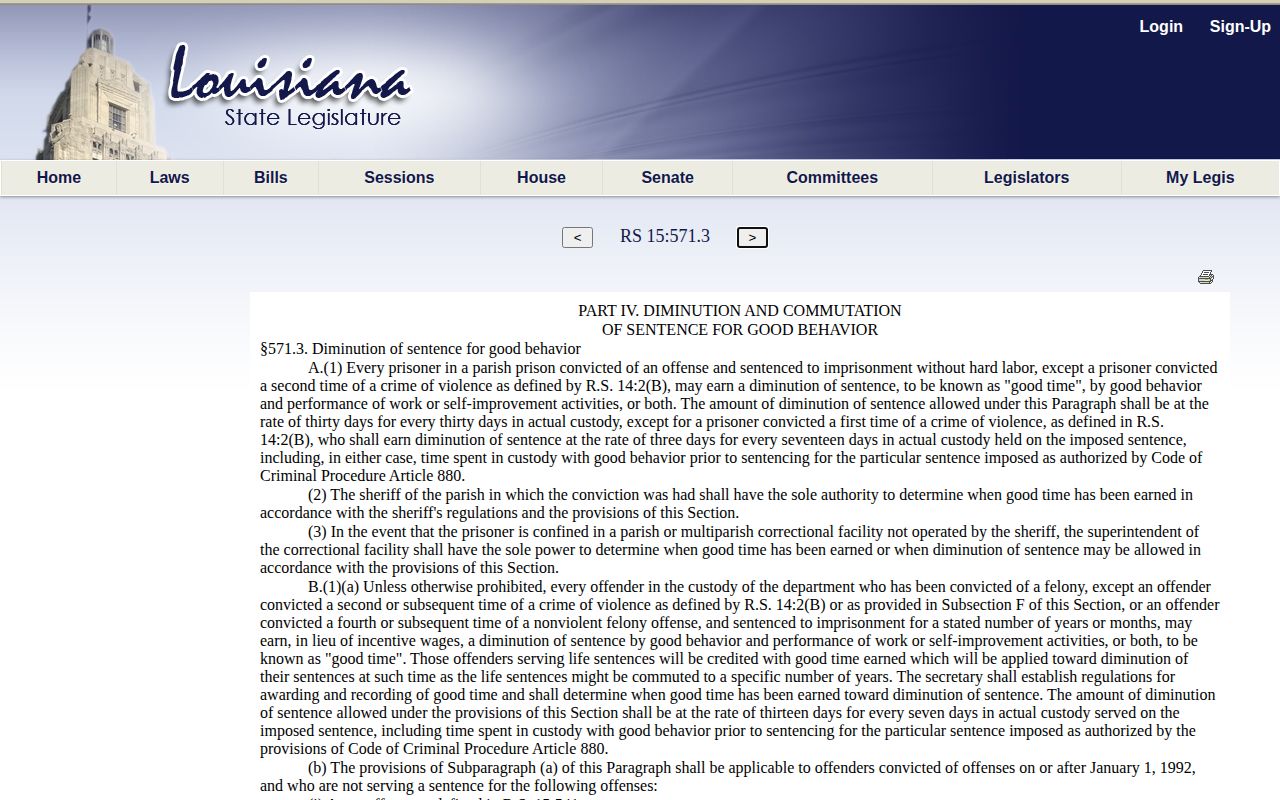
The supported conclusion is precise: 85% is not a blanket Louisiana rule, and no unofficial calculation should be presented as the person’s date.
Why St. Landry Release Dates Change
A projected release date can move when the records or legal conditions behind it change. Some changes add credit. Others remove it, delay release, or redirect the person to another custodian. The public locator may not be current to the minute, so note the lookup date and preserve the exact label shown.
| Factor | Possible effect | Record to verify |
|---|---|---|
| Sentencing paperwork | A date may be unavailable until the judgment reaches DPS&C | Court judgment and master prison record |
| Jail credit | Credited pre-sentence time can alter the computation | Commitment papers and computation record |
| Concurrent or consecutive terms | Sentence structure changes the calculated end | Judgment for every relevant count or case |
| Credit loss or restoration | Discipline and later restoration may move the estimate | Agency sentence-credit record |
| Appeal or resentencing | A corrected court order may change the term | Later court order and revised computation |
| Hold or detainer | One agency may end custody while another takes the person | Exit record and receiving-agency record |
| Parole action | Grant, denial, deferral, or rescission changes the path | Committee outcome and operational release record |
When dates conflict, ask the agency to identify the “as of” date and source record. Do not average two estimates or select the earlier one. A corrected computation should come from the office that maintains the master record.
St. Landry Parish and State Sentences
The office that computes a date depends on the commitment. A person serving a parish-prison sentence remains in a different records path from someone committed to Louisiana DPS&C. The court judgment identifies the sentence, while the responsible custodian applies credit and records the operational release. If the person moves from St. Landry Parish Jail into state custody, the parish exit date and the later state projected date describe different stages.
For a parish sentence, ask for the existing calculation and release records from the sheriff and the controlling court. The judgment should supply the imposed term, any express jail credit, and the structure of multiple sentences. The sheriff has the statutory earning determination for the parish good-time category described in R.S. 15:571.3. No public St. Landry calculator or fixed release schedule was found, so an outside estimate should not be substituted for that record.
For a DPS&C sentence, the master prison record controls the agency calculation. Official sentencing papers must reach DPS&C before the date may be complete. The locator can give a projected release date if applicable, and the time-computation number can route detailed questions. A public search screen is still only a lead. Formal proof comes from the underlying state record and the actual release entry.
Multiple cases can complicate either path. A bond or completed term in one case does not clear another sentence, warrant, or detainer. Read each case and ask the custodian to identify every hold that affects the exit. If another agency receives the person, record both the first agency’s release or transfer and the second agency’s intake. That distinction protects the meaning of the date.
St. Landry Parole Eligibility Dates
Parole eligibility is the point at which the Committee may consider a qualifying case. It is not a promised release date. R.S. 15:574.4 contains baseline fractions plus many exceptions. Current provisions include a 25% baseline for a generally eligible nonviolent person, 65% for a qualifying first violent case in the relevant cohort, and 75% for certain second violent or first or second sex-offense cases. Other classifications can be ineligible.
Individual eligibility turns on the offense, conviction cohort, prior record, sentence structure, exclusions, age-related provisions, and revocation history. A docket only shows that a hearing was scheduled. Verify the official Committee outcome, then confirm the actual prison exit and supervision assignment. A denial or deferral should never be converted into a new guaranteed release date from a typical reconsideration interval.
St. Landry Parish cases under state supervision are routed locally through the Ville Platte district. That office can help direct a public status inquiry, but it does not replace the sentencing record or DPS&C time computation.
Note: Eligibility permits review; it does not prove a favorable decision, completed paperwork, or physical release from state custody.
St. Landry Release May Include Supervision
A good-time date is not always the end of the full sentence. Louisiana R.S. 15:571.5 states that a DPS&C good-time release operates as if the person were released on parole. The person receives a certificate with conditions and remains under supervision for the rest of the original full term. Thus, “released” can accurately describe physical freedom while “under supervision” also remains true.
The official R.S. 15:571.5 text documents this post-release consequence.
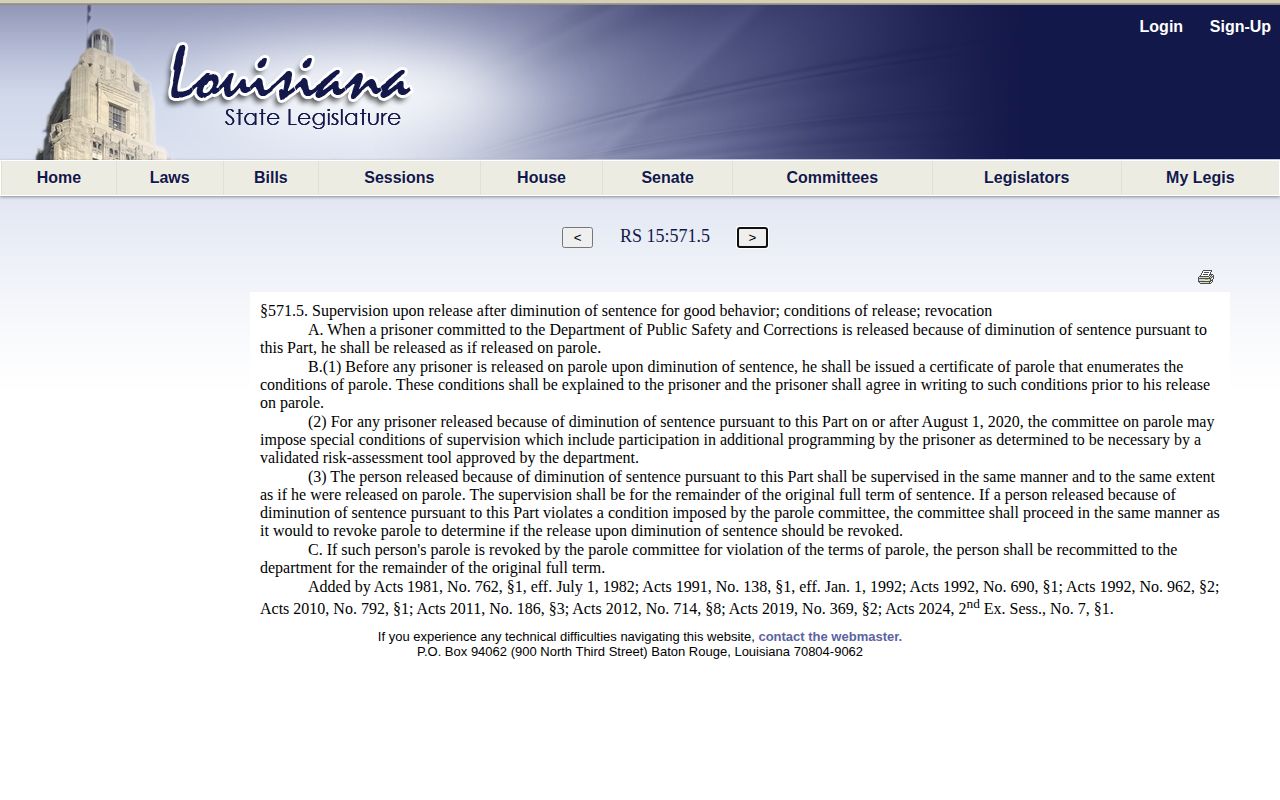
For that reason, a state locator result showing community supervision should not be treated as continued prison confinement. It also should not be called a full discharge without the final discharge record.
Confirm a St. Landry Release Date
Use alerts for timing and records for proof. A matched LAVNS record may permit notification registration for a custody change. The St. Landry VINELink check details the specific-person search and confirmation process. An alert remains agency-supplied notice, not a certified release document.
For a parish case, ask the sheriff for the existing booking and release record, including final date and time, authority, reason, and destination if maintained. For a state sentence, request the DPS&C master-prison or release record. Read the controlling court file in either path. This reconciles the estimate, the legal authority, and the actual event.
If another agency receives the person, continue with that agency. The last custodian’s exit and the next custodian’s entry are separate records. When a court order controls the change, the St. Landry Clerk’s criminal-record route can supply the durable legal record. That chain prevents a transfer from being described as a return to the community.