
St. Landry Booking Photo Records
A booking photograph documents identification at an arrest or jail intake. It is not a release record. The image cannot establish whether a charge ended in dismissal, conviction, acquittal, or another result. It also cannot show whether the person later left St. Landry Parish Jail for the community or for another custodian.
Louisiana R.S. 44:1 broadly includes photographs within the definition of public records used or retained for public business, subject to exceptions. R.S. 44:3 contains law-enforcement exemptions while treating booking records under Louisiana criminal procedure as public before final judgment. Those statutes support a targeted request, but they do not guarantee every image will be disclosed. Sealing, expungement, redaction, confidentiality, pending litigation, and the facts of the record can affect access.
Find St. Landry Released Mugshots
The official channels have distinct limits. No reviewed source established a retained parish gallery for people after release. Start with the agency that took the photo and the exact booking, then use other channels only for their stated scope.
| Channel | Photo finding | How to access |
|---|---|---|
| St. Landry jail roster | No photo visibly shown in the reviewed list view | Use only to test current roster custody |
| Sheriff mobile app | No advertised inmate or mugshot function | Do not treat it as a photo workaround |
| Sheriff records request | A specifically identified booking photo may be requested | Email the designated public-information address |
| Louisiana VINELink/DPS&C | Agency information may appear, but a historical photo is not promised | Search state custody, then request a specific releasable record |
| Court file | Legal records may verify the case, not necessarily supply the jail photo | Use the proper district or city court record |
| Commercial or news copy | An old arrest image may persist | Treat it as secondary and verify all facts officially |
VINELink is a custody and notification service, not a parish mugshot archive. Louisiana DPS&C sources do not promise a public historical photograph for every fully discharged person. DPS&C records also face statutory confidentiality limits. The narrow Sheriff request remains the clearest St. Landry route for the original booking image.
St. Landry Sheriff App Limits
The official St. Landry Parish roster is a timestamped list of incarcerated offenders. Its visible fields are name, date of birth, race, gender, and arrest date. The reviewed list did not visibly provide a photo, a release date, or a recent-releases archive. It should not be described as a booking-photo gallery.
The Sheriff also has an official iOS app. Its public feature description emphasizes news, crime reporting, tips, and community interaction. It does not claim inmate lookup, recent releases, or mugshots. The official app listing documents those features.
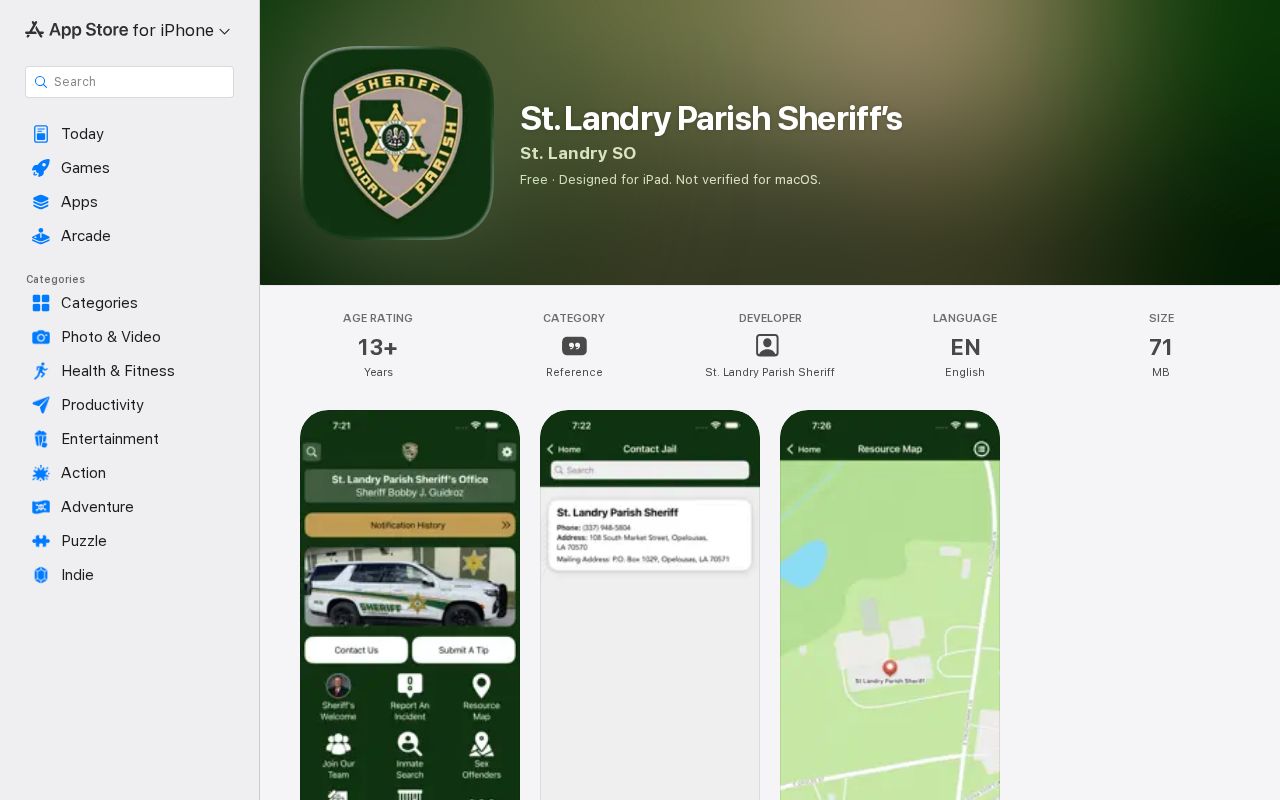
The captured listing supports a careful conclusion: the app is an official communications channel, but no mugshot-discovery feature can be claimed from its published description.
Note: The St. Landry 24-Hour Release List method also starts with records because no official recent-release feed exists.
Request St. Landry Booking Photos
The Sheriff directs legal, public-records, and public-information requests to pir@slpsheriff.com. Its contact page warns that using the general web form may delay a request. The Sheriff does not publish a dedicated booking-photo form, a local copy-fee schedule, a release-photo retention term, or a promised production time on that page.
- Identify the full booked name, date of birth or booking number if known, and an approximate booking date.
- Ask for the existing booking photograph tied to that one custody episode, plus the final booking/release sheet if release verification is also needed.
- Request electronic delivery and ask staff to advise of any charge before processing.
- If part is withheld, ask for the nonexempt portion and the legal basis for withholding the rest.
- Match the image and release sheet to the court case rather than drawing a case outcome from the photo.
The Sheriff’s official contact page lists the designated request route and Public Safety Complex contact. Louisiana law generally concerns access to existing records, not a duty to create a new image, certificate, or custom answer. A focused request is therefore more useful than asking for every record associated with a person.
The Sheriff may apply exemptions, redact protected matter, or explain that the image is not disclosable. A booking record can contain public material while another part remains confidential. The answer must be read on its own terms.
R.S. 44:33 distinguishes records that are immediately available from records in active use. R.S. 44:35 supplies a response benchmark after five days excluding weekends and legal holidays, but it does not guarantee full production in that period. The agency may need to identify the record, review exemptions, or give a reasonable estimate. No local promise should replace the actual response.
Louisiana Photos After St. Landry Release
A person transferred from St. Landry Parish Jail into state custody belongs in the Louisiana DPS&C path, not the local roster. Public VINELink/DPS&C results may show agency-supplied identifying information. The official sources reviewed do not promise that a historical DOC photograph stays available after full discharge.
For a specifically identified state record, contact DPS&C and request the releasable item that actually exists. R.S. 15:574.12 limits imprisoned-person records, so no full master file or photograph should be promised. A state result can also reflect parole, probation, transfer, or a projected event rather than completed release. Confirm the displayed agency, status label, record date, and any release event before connecting it to a St. Landry booking.
Identity must be matched with more than a similar name. Compare date of birth, booking or DPS&C number, reporting agency, and the known custody path. An image can be wrongly assigned when a copied page drops those details. If the state screen supplies no historical photo, request the identified record rather than borrowing an image from an unrelated source.
- Booking photograph
- An image made during intake; it does not prove the later case result.
- Release record
- The operational record of when and how one custody episode ended.
- Discharge
- An official end of the stated custody or sentence obligation, as the record defines it.
- Transfer
- A move to another custodian, not a return to the community.
St. Landry Mugshot Copies Online
Commercial aggregators may copy booking images from old snapshots. Such copies can be stale, mislabeled, or detached from the later court result. They cannot prove the date or type of release. No commercial mugshot publisher, data broker, or paid-removal service is linked or endorsed.
Sheriff announcements and local news reports may also carry an arrest image for an individual event. They are episodic sources, not a complete release archive. A dated story can establish only what was reported at that time. Compare it with the original agency record and the controlling court file before treating the identity or status as current.
The official legislative sweep found no verified Louisiana anti-pay-to-remove statute or categorical statewide mugshot-publication mandate applicable here. That absence should not be turned into a broad statement that every photo must stay online. Access to an agency record and proactive web display are separate issues.
A copied image may outlive changes to the original agency page. It may also omit a later dismissal, sentence, expungement order, or correction. The copy should never be used to infer that the person is still incarcerated. The St. Landry jail record, correct court file, and current receiving-agency record remain the sources for those questions.
St. Landry Mugshots and Expungement
Louisiana Code of Criminal Procedure articles 971 through 995 govern expungement, while R.S. 44:9 addresses arrest and prosecution records in relevant dispositions. Eligibility depends on the case result, offense, waiting period, prior history, and statutory exclusions. The research found no St. Landry-specific expungement clinic or local instruction set.
An expungement or sealing order can affect public access, but a missing public result does not prove that an order exists. It also does not justify rewriting history or assuming a specific case outcome. The Clerk, the signed court order, and the applicable law are the proper sources. Juvenile and other confidential records have added protections.
When an official image remains visible after a relevant order, contact the agency that controls the display and identify the order and record precisely. For a copied image, contact the publisher directly and provide the source correction or order that applies. Do not pay or endorse an unverified removal service.
R.S. 44:36 addresses government retention, including a general minimum when no other schedule applies. Retention is not the same as public online display. An agency may keep a record without placing it in a searchable gallery, and a public page may change without destroying the source record. Ask the custodian about the specific record rather than assuming web visibility tracks the retention period.
Note: Retention rules do not mean an image must remain searchable on the public web for the full retention period.